Football, Zionism, and Palestine Solidarity
For decades, St Pauli Football Club (FCSP, or St. Pauli) has served as an intersection of punk, football, and radical politics the world over. You can expect to see FCSP hoodies, hats or scarves at football matches, punk and hardcore shows, or anti-fascist street mobilizations. This international phenomenon has hit quite the hiccup lately, as the politics of a large contingent of FCSP supporters in their hometown of Hamburg, Germany have clashed with the broader international chapters of support over the ongoing genocide in Palestine. Many FCSP supporters, including most prominently Ultras St. Pauli (USP), in Germany have recently displayed signs of support for Israel and Zionism in the wake of the heightened genocidal onslaught of Palestinians. Meanwhile, football supporters throughout the world, many who have had friendly relations with St Pauli supporters in years past, have expressed support for Palestine and an end to the colonial occupation by Israel. This difference in politics has resulted in broken relations between St Pauli supporters and other football supporters across the world. This article will highlight the brief history of this trend of left-wing football, how international groups have interacted with local St. Pauli supporters, and conclude with some reflections on the role of radical politics in football.
BRIEF HISTORY OF FC ST. PAULI
Casual fans of St. Pauli may be shocked to hear that the football club of punks, freaks and anti-fascists did not start off with such political persuasions. Founded in 1910, the club not only survived World War II and the Nazi regime, but managed to do so because it had become part of the Nazi party. In its early years, the club had been socially associated with the bourgeoisie and the right-wing, in the eyes of workers in Hamburg as well as other clubs’ players. Wilhelm Koch, FCSP president from 1947 – 1969, had secretly been a member of the Nazi party while serving as president. In 1970, the FCSP stadium was named after Wilhelm Koch, and it wasn’t changed until 1998, when the proposal to change the name only narrowly passed. Similarly, a longtime FCSP club member had been a crucial member of the NSDAP & SS, and he was posthumously stripped of his club medals in 2010 by the St. Pauli General Assembly. As Carles Viñas and Natxo Parra write in “St. Pauli: Another Football Is Possible,” there was no resistance or heroism to Nazism, but neither was there fanaticism or blind allegiance. That the resolution to change the name of the stadium had only been passed by a slim margin also shows that as recently as the late 1990’s, there was not a strong current of anti-fascism within the St. Pauli General Assembly.
Despite having played along with mass fascism in Germany, in the 1980’s the club became a hub for punks, anti-fascists, and the working class. FCSP’s Stadium, renamed “The Millerntor” was located 1/2 kilometer from the base of a vibrant squatting movement that had attracted fierce solidarity from across Europe. Simultaneously, football in Germany had become incredibly popular for fascists and boneheads (Nazis who appropriate skinhead culture and fashion). FCSP began to attract “non-fascists” not because it was an anti-fascist football club, but because the fascists and boneheads had yet to infiltrate the physical space of the Millerntor and imbue it with their hatred and politics. New supporters from the squatting scene took it upon themselves to radicalize the Millerntor and make it an anti-fascist space. This practice of deeming social and cultural space as anti-fascist, no-go zones for fascists, is commendable and has been mirrored by militant anti-racists in the United States for decades. The anti-fascist aesthetic that FCSP is known for today was truly built from the ground up, yet is now used as a sleek marketing tool to sell clothes, coffee mugs, beer glasses, and all kinds of merchandise.
Over the years, the supporters made FCSP and their stadium the Millerntor the explicit anti-fascist space that it has come to be today. When FCSP banned racist, fascist and discriminatory language in flags and chants, it was at the behest of the fanzine, Millerntor Roar! Supporters lead the fight to push Nazis out of the Millerntor stadium, as Germany had a hostile and violent football scene in the 1990s. FCSP supporters also have had a strong history of taking a stand for left-wing causes, partnering with supporters from other clubs, like Borussia Dortmund and Redbull Leipzeg for particular match-day protests. As one member of Ultras St. Pauli (USP), a hardcore group of supporters for FCSP, expressed: “Being an ultra means going to demonstrations, protesting against neo-Nazis, and strengthening the club’s political commitment.”
One thing about the FCSP character and its culture that has been so attractive to Hamburg residents as well as international followers has been the club’s tie-in to its neighborhood district. The identity of the club is very much attached to the identity of the neighborhood that the Millerntor Stadium is located in: Hamburg’s red-light district. The neighborhood was historically a working-class port that attracted the lowest of society – precarious workers, strippers, brothels, immigrants, petty thieves, drunks and drug-users. The grit of making it through the ills of capitalism fosters a pride in not being of the privileged classes of society, and thus Hamburg and FCSP became safe havens for the downtrodden. If this connection between FCSP and its neighborhood has been a huge draw for international fandom, how and why do these international fan-clubs justify their devout following despite lacking that very same connection to the neighborhood? Perhaps this disconnect between international followers and the club they adore – yet do not live next to – can help explain the disconnect between international followers and domestic supporters that resulted from the split on whether to support Israel or Palestine. The following section will explore this split, as well as attempt a short history of international support for FCSP.
ULTRAS ST. PAULI BASTARDIZE “ANTI-FASCISM” WITH ULTRAS HAPOEL FRIENDSHIP
In 2014, Israel invaded Gaza in a military operation that resulted in the death of at least 1,400 Palestinians. While this particular military invasion is just one incident of many in the nearly 75 years since the Nakba, it is of specific interest here for the participation of members of Ultras Hapoel. Ultras Hapoel supports Hapoel Tel Aviv, a sports club in Israel with a football team and a basketball team. During the 2014 attack on Gaza, members of Ultras Hapoel took part in the military actions, evidenced by posing in pictures with their flag and tagging walls with “UH IN GAZA,” as well as adorning tanks with flags of Ultras Hapoel. After Palestinian resistance fighters had managed to kill 4 members of Ultras Hapoel, the sporting club paid tribute to them at a football match in Israel.
Part of Ultras St. Pauli’s ongoing commitment to “anti-fascism” has been a long-standing friendship with Ultras Hapoel. Within Israeli society, Ultras Hapoel is viewed as one of the more dissident football supporter groups, as they attempt to criticize the corruption of sporting organizations throughout Israel, and fall to the “left” of Israel’s political spectrum. Ultras Hapoel frequently uses communist imagery in their displays, such as Fidel Castro, the hammer & sickle, and several displays explicitly against racism and fascism. Their rivalry with Maccabi Tel Aviv, notoriously Israel’s “most racist soccer club,” may also give their politics more weight than they deserve.
Part of Ultras St. Pauli’s ongoing friendship with Ultras Hapoel has been expressed through USP’s own displays: USP flags are sometimes seen in UH sections, and during a St. Pauli FC match on October 21, 2023, USP displayed a banner reading “Hapoel Family – Always With You,” a clear expression of solidarity in the weeks following the escalation of Israel’s violent occupation of Palestine.
However, one of Ultras Hapoel’s main complaints with Israeli sports is the expedited citizenship processing granted to “foreigner” athletes in Israel. This is one of the few coherent political statements on their website, hard to overlook, yet another clear example of Ultras St. Pauli’s paperthin anti-fascism and leftist politics. The ongoing friendship between USP and UH represents the surface-level depth of anti-fascism of club leadership and supporters for St. Pauli FC – turning the other cheek regarding blatant xenophobia, and fraternal love for violent settler colonialism.
INTERNATIONAL SUPPORTERS & THE QUESTION OF ZIONISM VS ANTI-COLONIALISM
Given the development of an anti-fascist culture within the club and the stands of FC St. Pauli, it is understandable that an international cult following would develop given the overt commercialization of the sport across the world in stark contrast to the DIY and participatory character of the game and its culture. This has developed into many international fan clubs across the world as well as friendly relations with clubs in other leagues in other countries, which is uncommon in club soccer. These international clubs shared politics as well as fandom for the team on the pitch. The partnerships between clubs of different teams have taken many forms, from solidarity fundraisers to facilitating trips of Scottish football fans to Hamburg, or friendly matches between St. Pauli and soccer teams in the United States like the NY Cosmos, Detroit City FC, and the Portland Timbers academy team. Recently, the friendly relationships between supporters have fallen under extreme strain, to put it lightly, in the wake of Israel’s ongoing genocide in Palestine.
The conflict between international football clubs can be summed up in two different banner displays from FC St. Pauli and Celtic FC (a Glasgow, Scotland based team with an infamous history of rowdy anti-fascist supporters, the Green Brigade) during October 2023. The Green Brigade has a long history of showing support for anti-fascism, anti-colonialism, and rebel causes like the Irish and Palestinian liberation struggles. Ultras St. Pauli (USP) displayed banners at one game reading “From Gaza to Glasgow – Fight Antisemitism. Free Palestine From Hamas.” The banners’ messaging is clear – the main issue at stake in Gaza is not the colonial occupation of the Israeli state, but antisemitism, which USP claims is present in Glasgow as well due to the Green Brigade’s support for Palestine. Conflating anti-Zionism with antisemitism is an old trick that has been debunked by anti-fascist activists countless times over the years. Additionally, USP identifies that the political party responsible for corruption and violence in Palestine is not the Israeli state, but Hamas. USP’s propensity to side with the colonial state of Israel is implicit in these banners. Celtic FC supporters responded with banners of their own, reading “Fuck St. Pauli. Free Hamburg From Hipsters” accompanied by two Palestinian flags.
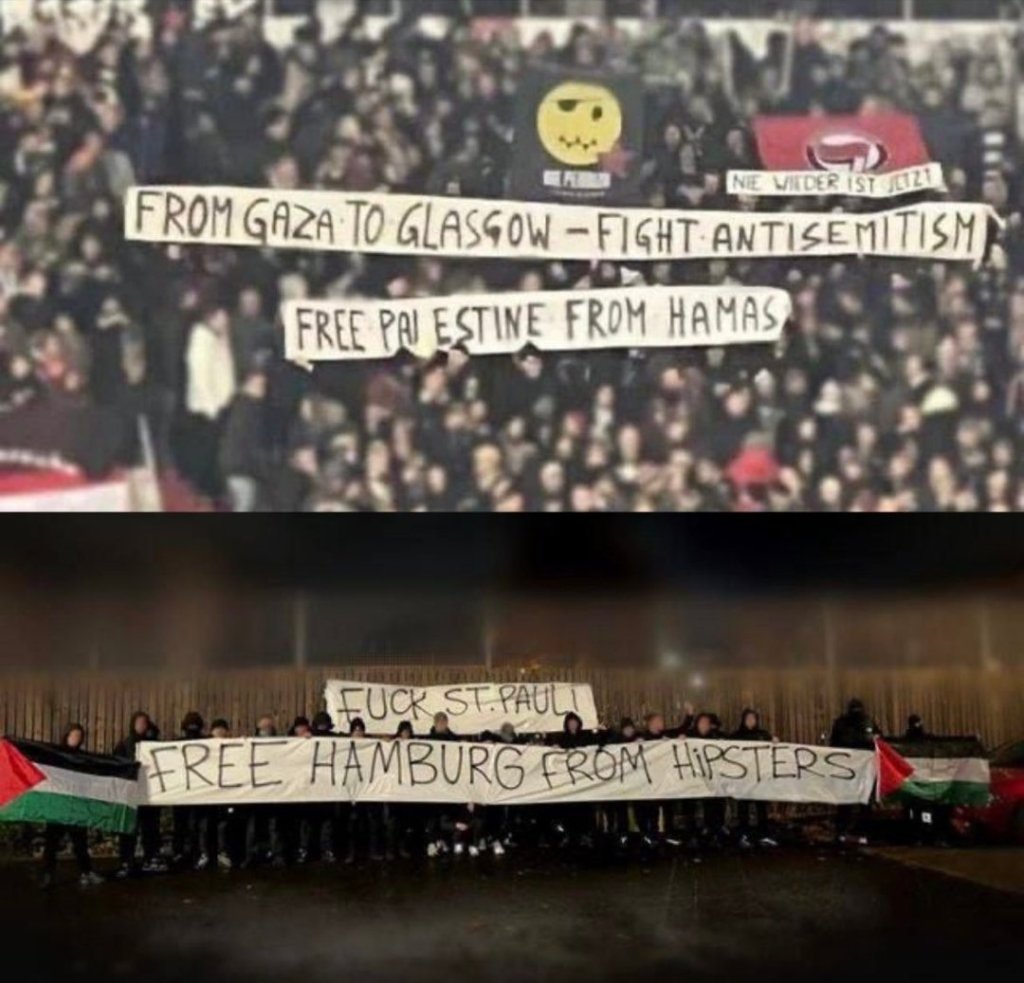
The Green Brigade had already been dealing with trouble from the board of their own club for displaying Palestinian flags in October after Israel’s renewed assault on Palestinians. For example, the entire ultras group have received several match bans for their persistent display of Palestinian flags at matches. Palestinian flags have long been a staple at Celtic FC matches, even before the founding of Green Brigade in 2006. Green Brigade is not alone in their expressions of solidarity with the people of Jenin, Palestine. They were accompanied by the Horda Azzurro ultras of German football club Carl Zeis Jena in August of 2023, after Israels’ brutal invasion and massacre of refugees in the Jenin Camp. This particular act of solidarity is worth highlighting as it signifies a group of football ultras not under the spell of German guilt and Zionism. As well, it occurred several months before the recent escalation – before when international displays of solidarity became more prominent in all levels of global society.
DISSOLVING INTERNATIONAL FANDOM
Perhaps most central to the FCSP and their supporters has been the open hostilities and dissolving of several international supporters’ clubs. After weeks of opposing stances, attempts at discourse and accountability, three groups central to international support for FCSP issued statements denouncing USP’s Zionism and announcing their disbandment: FC Sankt Pauli Fanclub Catalunya, FC St. Pauli Bilbao, and Glasgow St. Pauli. Glasgow St. Pauli wrote that the split was caused by the surprise of “incompatible humanitarian beliefs with our own club and fans” and accused FCSP of picking and choosing when to apply antifascism. FCSP Fanclub Catalunya expressed that the contradictions and conflicts regarding Palestine solidarity had crossed a line never crossed before, adding “we cannot be in a club where the predominant voice is that of the tyranny of a genocidal state.” It wasn’t simply the clash of political opinions regarding the genocide in Palestine, but that the fanclubsprecherrat (FCSR) – the governing body of FCSP supporting clubs – had officially labeled expression of support for Palestine in the wake of Israel’s aggressions as “very controversial.” FCSR had even gone so far as to accuse FCSP groups expressing solidarity with Palestine of supporting Hamas, despite clear condemnations of that group in their statements.
Meanwhile, many international FCSP fanclubs have remained silent on the issue altogether, including but not limited to the groups in Atlanta, GA and London, England. For FCSP’s draw being so particularly interwoven in radical anti-fascist politics, the selective silence on the issue of genocide and colonial occupation in Palestine is appalling. Moreover, this confusing inconsistency in regard to FCSP supporters’ politics draws attention toward the bizarre issue of German guilt. It feels lazy to assuage blame for support of a violent apartheid state on Germany’s guilt for past participation in similarly atrocious acts of brutality and annihilation. Is it possible that the radical politics of FCSP and Ultras Sainkt Pauli were only paper thin? In the United States, there’s an interesting dynamic growing in the wake of Trump’s presidency, where much of U.S. society felt compelled to fight and smash the Proud Boys. This street-level fraternal gang of chauvinists and misogynists were enough to excite many liberals into allowing the exception of violence regarding preventing Proud Boy activity – but U.S. society at large seems undecided regarding how to address and respond to Israel’s violence against Palestinians. Can we locate a parallel in German anti-fascism, as it relates to a staunch domestic anti-fascism yet sponsoring colonialism in the Middle East?
CRITICAL QUESTIONS & REFLECTIONS OF FCSP SUPPORTER CULTURE
Over the years, FCSP supporters have often gone to great lengths to organize support, material and symbolic, for refugees and immigrants in Germany. This stands in stark contrast to their lack of support for Palestinians, who are actively being turned into refugees and having their homelands stripped from them. Do “non-Germans” have to be refugees and landless in another country for FCSP supporters to deem them worthy of support? The exception of course was a giant banner display in support of Rojava, a revolutionary project in Kurdistan that has (rightly so) attracted the attention of radicals the world over. This dualism reeks of paternalism, limiting support to immigrants and refugees who must fit a metric in order to receive the good German solidarity – if you’ve left your home country we will welcome you, but if you are fighting to remain home, we will disdain you.
Given this lapse in anti-fascism and international solidarity in FCSP’s present, the question remains: Is FCSP’s anti-fascism a mere reaction to German society, rather than a radical vision for the future? Are the aesthetics of punk anti-fascism, charity of “Refugees Welcome,” and joys of international football simply results of German guilt for having played along with Nazism for several decades?
All of this begs for some sort of introspection on behalf of radical anti-fascist soccer fans outside of Germany. That so many of us were seemingly duped into cultish fandom, whether passive or active, for St. Pauli, while so many contradictions have been just barely below the surface, reflects poorly on our politics as well. We cannot sacrifice diligence and integrity for cultural identity in a sea of commercialized fandom. Our allegiances, alliances, friendships and solidarities across borders and team loyalties must be subject to some amount of scrutiny regarding our politics, beliefs and affiliations if we are to find a way beyond capitalism and the state and its fascist border mechanisms. I personally don’t want to share the stands, or the streets, with active participants in and celebrators of colonial genocide.
CONCLUSION
What this family feud reveals to radicals who love football, footballers committed to anti-fascism and anti-racism, and those in between, is that the politics of Zionism and support for Israel are deeply entrenched in all levels of society – but so is the politics of anti-colonialism and support for sovereignty and liberation. For leftists unfamiliar with or uninterested in sport and fandom for football clubs, this international political debate can perhaps illustrate the ways that club loyalty can transcend what is often decried as “micro-nationalisms” by critics of sport fanaticism. For FCSP international clubs in Glasgow, Catalunya, and the Basque Region, participating in FCSP support was a vehicle for enacting their politics of internationalist anti-fascism. The distinct highs of supporting your chosen football club, while intertwined with politics of solidarity, often eclipse the kinds of emotional peaks achieved in militant street demonstrations – and they can happen much more frequently. It should not be treated as any small task that the members of these international support groups decided to disband and cease support for FCSP — far more important than giving up on a punk band that no longer represents your politics, much more similar to breaking up with an intimate partner over an irreconcilable difference.
For radical anti-fascist fútbolistxs, this divorce from FCSP may feel like losing a family member, but this family can also feel massive and ever always shifting. A banner once appeared reading “THE REBEL’S CHOICE:” with the logos of four European football clubs: Celtic FC, Olympique Marseille, FC Saint Pauli, and AEK Athens. While FCSP’s absence from this international band of football rebels will be felt bitterly, and many conflicts are bound yet still to rise from this split, the Eurocentrism of this aesthetic remains loud. There are fútbolistxs across the world who have participated in militant radical politics, in the streets and the terraces, that demand our attention just as much as the antifa ultras of Europe. Antifascist fútbol fans throughout Central and South America have a long and colored history of standing for their club and their politics. Supporters of Colo-Colo, a Chilean soccer club, were prominent in the street demonstrations in Santiago that shook the country into rewriting its constitution in late 2019. FC Palestino, another Chilean club founded by Palestinian immigrants in the early 20th century, regularly flaunts its connection to Palestine and its supporters flock to the stadium with Palestine flags in hand.
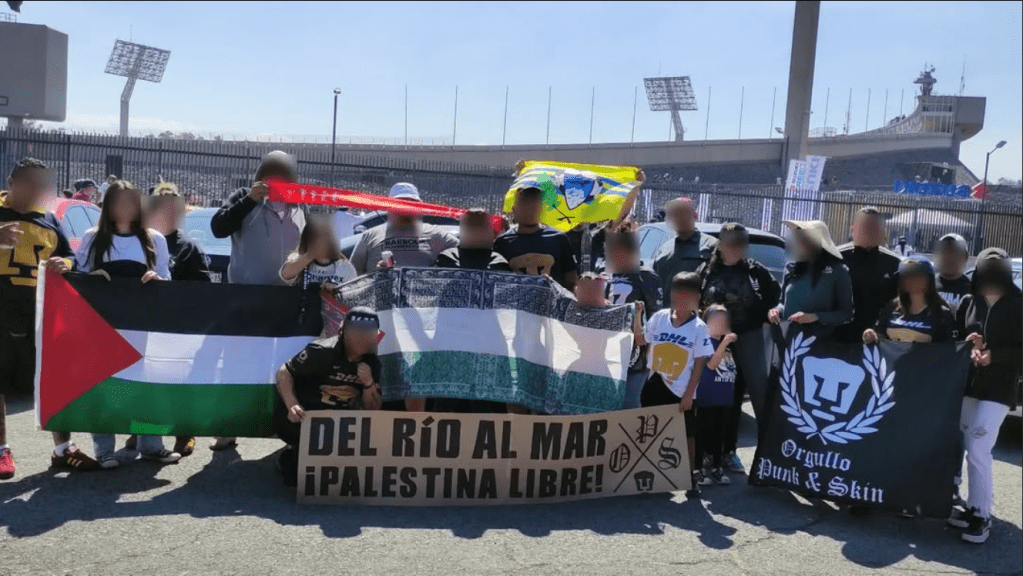
Supporters, sometimes referred to as hinchas or barras throughout Latin America, have shown support for Palestine in street demonstrations as well as continue to show their radical ethos in other ways. Orgullo Punk y Skin, anti-fascist supporters for Mexican club Pumas UNAM, posed with a Palestinian flag and a banner reading “DEL RIO AL MAR” (from the river to the sea) before a home match in early November 2023. Earlier this March, they participated in a nationwide feminist march. There are countless more examples of radical and militant anti-fascism held by football supporters throughout Southeast Asia, Africa, and beyond and this article simply does not have space to document them all (though that would be a fascinating topic of research for any willing sporting antifas reading this).
One thing is for certain though – the chapter of broad international respect and affinity for the politics of FCSP has come to a close. As one door closes, many more open. While we have lost an institution in international anti-fascism, one that has united punks, skinheads, antifas, and football hooligans, we’ve gained many reasons to build and invest time in grassroots, independent and radically militant sporting alternatives closer to our backyards. Let us proclaim an end to the experiment of a different kind of football in Saint Pauli, so that we can begin many more new ones.
See you in the stands, see you in the streets.
SUGGESTED READING
Carles Viñas & Natxo Parra, “St. Pauli: Another Football Is Possible.” Pluto Press. 2017.
Nicholas Blincoe, “More Noble Than War: A Soccer History of Israel-Palestine.” Bold Type Books. 2019.
Gabriel Kuhn, editor. “Soccer Vs. The State: Tackling Football and Radical Politics.” PM Press. 2019.
James Montague, “1312: Among the Ultras.” Pluto Random House. 2021.
 Critical Confluences